

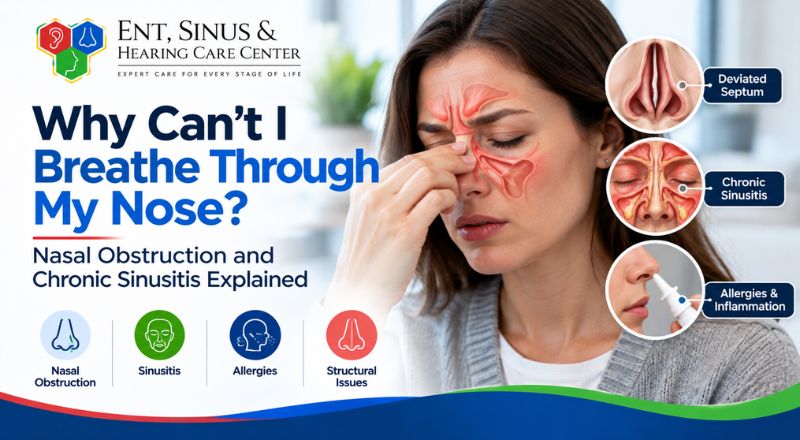
Why Can’t I Breathe Through My Nose? Nasal Obstruction and Chronic Sinusitis Explained
ENT, Sinus & Hearing Care Center diagnoses and treats nasal obstruction and chronic sinusitis in adults and children. Dr. Daniel Samadi is a board-certified otolaryngologist overseeing every evaluation at our Paramus clinic.
Why Can’t I Breathe Through My Nose for So Long?
Persistent nasal blockage is one of the most common reasons adults visit our ENT clinics in Paramus. Many arrive after years of allergy pills, sprays, and repeated antibiotics, asking: why can’t I breathe through my nose when I have tried everything?
The missing piece is usually a precise diagnosis. Each cause of nasal obstruction responds to a different treatment. A spray cannot straighten a septum, and surgery cannot cure an allergy. ENT specialists always first identify the root cause of airway narrowing.
What Causes Nasal Obstruction?
Nasal obstruction is a reduced flow of air through one or both nasal passages. Patients often ask why they can’t breathe through their nose. The answer is usually classified into two groups: structural and inflammatory causes.
Structural problems can refer to movement of the septum, enlargement of turbinates, nasal valve collapse, and nasal polyps. Allergic rhinitis, nonallergic rhinitis, chronic sinusitis, and rebound congestion are the common culprits related to nasal inflammation. It can also happen from decongestant sprays.
If your blockage is over 4 weeks old, it demands an otolaryngologist’s evaluation. ENT, Sinus & Hearing Care Center in Paramus, North Jersey can treat nasal obstruction caused by any cause.
Structural Causes of Nasal Obstruction
Structural causes imply obstruction that occurs due to a change in the physical shape of the nose. It can be associated with bone, cartilage, or tissue moving into the wrong position. Medication can decrease swelling in these areas, but it does not correct the structural issue.
Deviated Septum
The septum is the wall of cartilage and bone that divides the two nasal pathways. This wall is not erect in most of the adults; it has a slight lean. A prominent deviation can increase nasal airflow resistance on one side. It is a common culprit if one side of the nasal passages is always blocked.
Enlarged Turbinates
The turbinates are ridges of bone and soft tissue that warm and moisten the air as it enters the respiratory tract. They can get enlarged due to months of exposure to allergens or irritants on both sides (inferior turbinate hypertrophy).
Nasal Valve Collapse
The narrowest part of the airway is the nasal valve, which is located inside the nose. The side wall will collapse inward with each breath if it is not supported. This area becomes weak because of aging, injuries, and previous nasal surgeries.
Nasal Polyps
Nasal polyps are soft, noncancerous growths of the lining of your nasal cavity and sinuses. Common nasal polyp symptoms are nasal blockage on both sides, thick nasal drainage, and hyposmia (decreased sense of smell).
Inflammatory Causes of Nasal Obstruction
Inflammation refers to the swelling of the lining of the nose and sinuses. This blockage is frequently seasonal and environmental. It generally responds well to medical therapy.
Allergic and Nonallergic Rhinitis
People with allergic rhinitis are triggered by pollen, dust mites, mold, or pet dander. Their exposure triggers histamine release that swells the nasal lining. Nonallergic rhinitis causes the same swelling, but it happens due to cold air or smoke.
Chronic Sinusitis
The sinuses drain through a narrow channel system, the ostiomeatal complex. Inflammation of the mucous membranes can narrow this channel, slowing the movement of mucus out of the sinuses.
Chronic Sinusitis is diagnosed if the symptoms have been persistent for 12 weeks. It requires at least 2 of the 4 chronic sinusitis core symptoms plus either nasal endoscopy or sinus CT scan:
- Nasal blockage: Blockage on one or both sides.
- Discolored drainage: Thick mucus from the nose or down the throat.
- Facial pressure: Feeling full or painful in the cheeks, forehead, or eyes.
- Reduced smell: Partially or completely losing the sense of smell.
Chronic sinusitis is primarily inflammatory rather than an ongoing infection. The 2025 AAO-HNS adult sinusitis guideline therefore advises against routine antibiotics outside of an acute flare.
Rebound Congestion From Decongestant Sprays
Topical decongestants such as oxymetazoline shrink the swollen tissue within minutes. You should not use it more than three consecutive days, as they can trigger rhinitis medicamentosa. In this condition, the lining swells more severely when the dose results become weaker.
The symptoms of nasal spray rebound congestion are similar to chronic sinusitis, so patients often look for medical guidance.
Deviated Septum vs. Sinusitis
The primary symptoms are similar, but their patterns differ. Doctors often notice these clues at an initial evaluation.
| Clinical clue | Deviated septum | Chronic sinusitis |
| Side affected | Usually one side, consistently | Often both sides |
| Sense of smell | Usually normal | Often reduced |
| Drainage | Minimal | Thick, often yellow or green |
| Facial pressure | Uncommon | Common |
| Response to steroid spray | Limited | Often significant |
The two conditions frequently coexist, so our evaluation assesses both.
Why Nasal Congestion Often Gets Worse at Night
The nose has a natural rhythm called the nasal cycle. Every few hours, the lining on one side swells, and the other side shrinks. Lying down adds the force of gravity. This explains why many people can’t breathe through their nose at night on the side they sleep on. This pattern is normal.
Blockage that stays on one side regardless of position is related to a structural cause.
Two Clinical Clues You Can Observe at Home
You can get useful information for your condition, but this does not replace a medical checkup.
- Cottle check: Place a finger on the cheek beside one nostril and gently pull the skin toward the ear. A notable improvement in airflow suggests a link to the nasal valve.
- Steroid spray trial: Use an over-the-counter intranasal corticosteroid spray daily for two to four weeks. Spray it toward the outer wall of the nose. Marked improvement may suggest inflammation contributes.
North Jersey Conditions That Can Worsen Nasal Congestion
Environmental factors in North Jersey prolong nasal congestion for many locals:
- Spring: Oak and birch pollen cause allergies from March through May.
- Summer: Grass pollen peaks from late May into July.
- Fall: Ragweed circulates from mid-August until the first hard frost.
- Winter: Heating systems dry the nasal lining and thicken mucus.
- Year-round: Damp basements contribute to mold growth.
How to Diagnose Nasal Obstruction
- Symptom scoring: Patients complete the SNOT-22. It is a validated 22-question survey on how nasal symptoms affect sleep, function, and mood. It also sets a baseline for tracking results.
- Nasal endoscopy: After a numbing spray, the specialist examines the septum, turbinates, valve, and sinus openings with a thin camera. This process only takes a few minutes.
- Imaging when indicated: A sinus CT scan confirms chronic sinusitis and maps anatomy before any procedure.
Treatment Options for Nasal Obstruction and Chronic Sinusitis
Treatment depends on the diagnosis. Most patients begin with medical therapy, and we recommend procedures only when medication does not provide adequate relief:
- Medical therapy: Daily saline irrigation with distilled or boiled water. You can also use a steroid spray and treat allergies.
- Swollen turbinates treatment: When turbinates remain enlarged after two to three months of medical therapy, radiofrequency or microdebrider turbinate reduction shrinks them through the nostrils.
- Septoplasty: This procedure straightens the septum through the nostrils, with no external incisions.
- Balloon sinuplasty: Doctors perform this procedure under local anesthesia. A small balloon widens the sinus openings without removing tissue.
- Advanced options: Functional endoscopic sinus surgery (FESS) treats extensive disease. Biologic medications are used for severe polyps that recur.
Balloon Sinuplasty vs Septoplasty
These procedures address different problems. Balloon sinuplasty opens sinus drainage pathways, while septoplasty corrects the septum. Some patients benefit from both in one session.
Most patients resume normal activity within one to two days after balloon sinuplasty. Septoplasty will require one week away from work and two to three weeks before strenuous exercise.
Expert Sinus Care From a Board-Certified ENT
Are you looking for an ENT doctor in Paramus, NJ? Residents rely on Dr. Samadi for complex sinus problems. He has received Johns Hopkins and NYU training and has a strong clinical focus on chronic sinusitis and sinus surgery.
Our clinic holds more than 1,000 five-star verified reviews. Same-day appointments mean patients do not wait months to learn why they can’t breathe through their nose. Contact us now!
People Also Ask
Why can’t I breathe through my nose even when I am not sick?
Being unable to breathe normally through your nose without a cold points to a structural issue or chronic inflammation. Some of the common causes are a deviated septum, enlarged turbinates, nasal polyps, allergies, chronic sinusitis, and overuse of decongestant spray. The cause is identified by an ENT examination (endoscopy of the nose).
Is it normal for one side of the nose to be blocked?
One-sided blockage is normal if it occurs every few hours, alternating. This is called the nasal cycle. Failure to have alternating blockage may be a sign of a deviated septum, a polyp, or, rarely, a cancerous growth.
When to consult a doctor about congestion that won’t subside?
Seek ENT help if you experience congestion for longer than four weeks, it happens frequently, and you do not respond to a steroid spray. Get immediate attention if bleeding occurs from one side, numbness or swelling around the eye, or vision changes.
Is chronic sinusitis curable?
Most patients achieve long-lasting control, although chronic sinusitis often behaves as a condition to manage rather than cure. Surgery may improve drainage when appropriate, but chronic inflammation can require ongoing care. The tendency toward inflammation often remains, so many patients continue rinses or sprays.
Can a deviated septum cause chronic sinusitis?
Not on its own. A severe deviation can crowd the sinus openings and impair drainage, and an ENT may correct both problems in one procedure.
Can nasal obstruction affect sleep?
Nasal obstruction forces mouth breathing, which leads to snoring and fragmented sleep, and it can worsen obstructive sleep apnea. Treating the blockage often improves sleep quality.
Schedule a Nasal Breathing Evaluation in Paramus, NJ
If you continue to ask, “Why can’t I breathe through my nose?”, an accurate diagnosis is the first step toward lasting relief. Our team identifies the cause and outlines every appropriate option.
We provide chronic sinusitis treatment in New Jersey that patients can begin quickly, with same-day and next-day appointments available. Patients visit us from Hackensack, Ridgewood, Fair Lawn, River Edge, Oradell, Maywood, and communities across Bergen County.
