

What is the New Inspire Sleep Apnea Treatment: Who Qualifies and Results
CPAP remains the first-line therapy for obstructive sleep apnea. Many patients still stop using CPAP because of mask discomfort, air pressure, dry mouth, or noise. Large studies report CPAP nonadherence rates between 29% and 83%.
Untreated sleep apnea raises your risk of high blood pressure, stroke, heart disease, and drowsy driving. Numerous patients cannot tolerate CPAP, and they are praising the new Inspire sleep apnea treatment. It is a mask-free option with more than a decade of clinical data behind the therapy.
What Is Inspire?
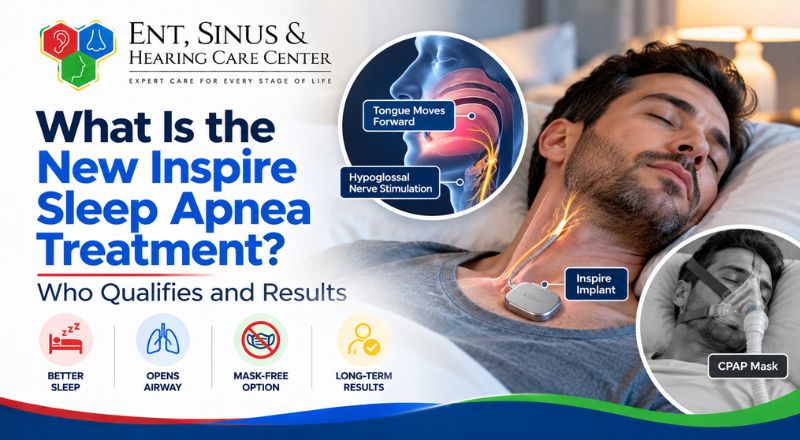
Inspire is an FDA-approved implant for moderate to severe obstructive sleep apnea. A small generator in the upper chest sends mild pulses to the hypoglossal nerve, which controls tongue movement.
The tongue moves forward and keeps the airway open during sleep. You turn the device on at bedtime with a handheld remote and off when you wake.
The FDA approved the first Inspire system in 2014. Surgeons have since implanted the Inspire sleep apnea treatment in more than 120,000 patients worldwide.
How Inspire Opens Your Airway
During sleep, the tongue and throat muscles relax. In obstructive sleep apnea, the relaxed tongue falls back and blocks the airway. Oxygen levels drop, and the brain wakes you briefly to restart breathing. The Inspire sleep apnea treatment prevents this collapse through a nightly sequence:
- Activation: You press the remote before bed, and the device waits for you to fall asleep before starting.
- Breath detection: The generator tracks your breathing pattern.
- Stimulation: With each breath in, a lead on the hypoglossal nerve delivers a mild pulse.
- Airway opening: The tongue moves forward, and air flows without obstruction.
Doctors call this approach hypoglossal nerve stimulation. The pulse matches your breathing rhythm, so the tongue moves only when you inhale.
What Is New About Inspire V
Inspire V received FDA approval in 2024 and replaced the Inspire IV system. The earlier system relied on a separate sensing lead placed between the ribs to detect breathing. Inspire V builds this sensing into the generator, so surgeons implant one lead instead of two. For most patients, the Inspire V vs Inspire IV difference means a simpler operation with the same core therapy.
| Feature | Inspire IV | Inspire V |
| Breathing sensor | Separate lead between the ribs | Built into the generator |
| Implanted leads | Two | One |
| Implant time | Baseline | 20.4% shorter |
| Breath timing accuracy | 79.4% | 87.1% |
| Charging | None | None |
The Inspire V clinical study followed 44 patients. Median AHI fell from 34.4 to 8.4 events per hour, and no patient required a device revision or removal. The Inspire battery is designed to last about 10 years and is not rechargeable.
Inspire Candidacy Requirements
The FDA label and insurer policies set clear limits on who qualifies for Inspire. Your ENT and sleep physician confirm each requirement before surgery:
- Diagnosis: Moderate to severe obstructive sleep apnea, with an AHI between 15 and 100 events per hour.
- CPAP history: Documented intolerance of CPAP or inadequate benefit from CPAP.
- Age: Adults aged 18 and older who fulfill the diagnostic criteria. Adolescents with Down syndrome may qualify under separate criteria, including a different BMI limit and additional airway evaluation.
- Weight: The Inspire BMI limit for Inspire V stands at 40.
- Apnea type: Central apneas account for less than 25% of total events.
- Airway pattern: Sleep endoscopy shows no complete concentric collapse at the palate.
Patients with a BMI above 40 often reach the threshold through medical weight loss or bariatric surgery. Your physician coordinates this plan with your sleep care.
Drug-Induced Sleep Endoscopy
DISE shows how your airway collapses during sleep. Under light sedation, your surgeon passes a thin, flexible camera through the nose and observes the airway as you breathe.
The exam identifies the site and pattern of collapse. A ring-shaped closure at the palate, called complete concentric collapse, responds poorly to Inspire and rules out candidacy. The procedure lasts about 15 to 20 minutes, and you return home the same day.
Inspire Vs. CPAP and Other Implants
Several treatments now address moderate to severe sleep apnea. Each option differs in equipment, surgery, and eligibility. Comparing them side by side helps you and your physician choose the right fit.
Inspire vs CPAP
CPAP delivers air pressure through a mask from an external machine. Inspire uses nerve stimulation from an implanted device. CPAP stays the first choice for patients who tolerate CPAP well.
| Factor | CPAP | Inspire |
| Nightly equipment | Mask, hose, and machine | Handheld remote |
| Surgery | None | One outpatient procedure |
| Travel | Machine and supplies | Remote only |
| Noise and air pressure | Present | None |
| Best suited for | All severities, first-line use | CPAP-intolerant moderate to severe OSA |
A 2026 study compared 3,525 Inspire patients with 3,525 matched CPAP patients. The Inspire group showed lower odds of stroke, heart attack, and atrial fibrillation. These findings come from an observational database, and research on cause and effect continues.
Inspire vs Genio and Aura6000
Three nerve stimulation implants now hold FDA approval. The 2026 American Academy of Sleep Medicine comparison lists these differences:
| Feature | Inspire V | Genio 2.1 | Aura6000 |
| AHI range | 15 to 100 | 15 to 65 | 15 to 65 |
| Maximum BMI | 40 | 32 | 35 |
| Incisions | Neck and chest | Neck only | Neck and chest |
| Power source | Implanted battery, about 10 years | External wearable, daily charging | Implanted battery, about 15 years |
| MRI access | Conditional at 1.5T and 3T | Conditional at 1.5T and 3T | None |
Inspire V covers the widest AHI and BMI ranges of the three systems. Genio avoids a chest incision but requires a wearable and daily charging.
Surgery and Recovery
Surgeons place Inspire during outpatient surgery under general anesthesia. Most patients return home the same day. Inspire surgery recovery follows a standard timeline:
- Surgery day: The surgeon places the stimulation lead through a small neck incision and the generator through a chest incision.
- Weeks 1 to 2: Most patients resume light activity within a few days. Avoid heavy lifting and strenuous exercise while the incisions heal.
- About 1 month: Your physician activates the device in the office and sets the starting strength.
- Months 2 to 3: A titration sleep study adjusts the settings for your airway.
Clinical Results
Long-term trial data support Inspire as an established therapy. In the STAR trial, median AHI fell from 29.3 to 9.0 events per hour. Epworth Sleepiness Scale scores dropped from 11 to 6, a meaningful reduction in daytime sleepiness. Only 2% of patients required revision surgery.
The ADHERE Registry, which tracked 5,000 patients across 61 centers in the United States and Europe, reported results in line with the STAR trial. Registry data also showed strong nightly device use.
Possible Risks and Side Effects
Serious complications remain rare. Most Inspire side effects stay mild and resolve with time or a settings change:
- Incision discomfort: Soreness at the neck and chest during early healing.
- Tongue irritation: Soreness from tongue movement against the lower teeth.
- Stimulation sensation: Tingling or discomfort that resolves with settings adjustment.
- Infection: Uncommon, treated with antibiotics and, in rare cases, device removal.
Insurance Coverage and Prior Authorization
Medicare and most major commercial insurers cover Inspire for patients who meet the criteria. Coverage requires prior authorization. Insurers will request these records:
- Sleep study: A recent test confirming moderate to severe obstructive sleep apnea.
- CPAP documentation: Records showing a CPAP trial and intolerance.
- BMI: A current measurement within the approved range.
- Endoscopy results: DISE findings confirming a suitable airway pattern.
Sleep Apnea Care in Paramus
Effective sleep apnea care starts with a full airway assessment. Dr. Daniel Samadi, a board-certified otolaryngologist, evaluates the nose, throat, and airway as one system. Patients seeking sleep apnea treatment in Paramus, North Jersey receive a clear review of every option.
Dr. Samadi reviews your sleep study, examines your nasal and throat anatomy, and explains all appropriate choices, including Inspire, CPAP adjustments, oral appliances, and nasal surgery.
Frequently Asked Questions
What is the new Inspire sleep apnea treatment?
The new Inspire sleep apnea treatment refers to Inspire V, the latest generation of the Inspire implant. Inspire V detects breathing inside the generator and requires one lead instead of two. Surgery takes less time, and the device keeps your airway open without a mask.
How does Inspire work during sleep?
Inspire senses each breath and sends a mild pulse to the nerve controlling your tongue. The tongue moves forward and keeps your airway open. You control the device with a remote.
Does insurance cover Inspire?
Medicare and most major commercial insurers cover Inspire when you meet the criteria. Plans require prior authorization, a recent sleep study, and documentation of CPAP intolerance.
Does Inspire V need charging?
No. Inspire V runs on an implanted battery lasting about 10 years. A minor outpatient procedure replaces the generator when the battery depletes.
Is Inspire safe with an MRI?
Inspire V allows MRI scans at 1.5T and 3T under specific conditions. Inform your imaging team about your implant before any scan.
Book an Inspire Evaluation
Schedule a consultation with Dr. Samadi in Paramus, NJ, to find out whether the Inspire sleep apnea treatment fits your needs.


