

What Is a Branchial Cleft Cyst? Types, Causes, and Symptoms
Did you find a new lump in your neck, or in your child’s neck? Most people fear cancer first. A new neck lump has several possible causes. A branchial cleft cyst is one possibility, especially in children and young adults, but an examination is needed to identify the cause. The cyst often stays hidden for years, and then a cold makes the lump swell.
Branchial Cleft Cyst Definition
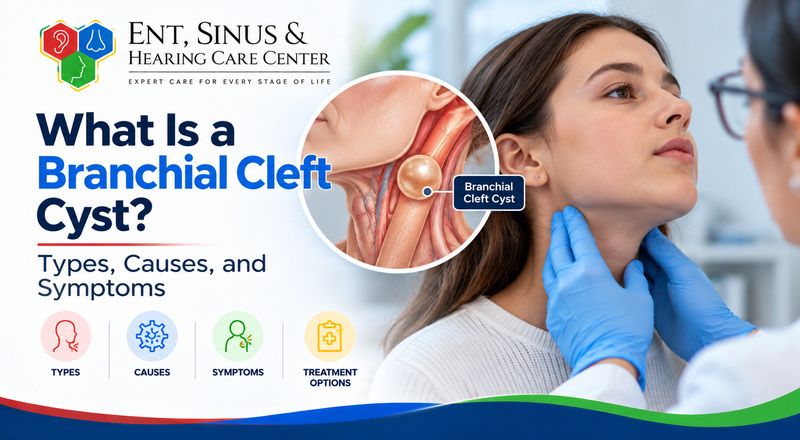
What is a branchial cleft cyst in medical terms? A branchial cleft cyst is a benign, fluid-filled neck lump. Leftover tissue from early fetal development forms the cyst. Most cysts sit on the side of the neck, in front of the sternocleidomastoid muscle and below the angle of the jaw.
The cyst exists at birth but often shows up in childhood or early adulthood, when the lump swells or gets infected. An ENT doctor (otolaryngologist) diagnoses and removes the cyst.
Causes of Branchial Cleft Cyst
Fetal development explains what a branchial cleft cyst is and why the cyst forms. Between weeks 4 and 7 of pregnancy, the embryo grows ridges in the neck called pharyngeal arches. Grooves called clefts sit between the arches. By week 7, the clefts normally close and disappear.
Sometimes part of a cleft stays open. The leftover pocket keeps a lining, and the lining keeps making fluid. The remnant takes one of three forms:
- Cyst: A closed pocket with no opening to the skin or throat.
- Sinus: A tract with one opening, usually a small pit on the neck skin.
- Fistula: A full tract from the neck skin to the inside of the throat.
Nothing you did during pregnancy causes these cysts. Most occur by chance. Cysts on both sides of the neck raise concern for branchio-oto-renal syndrome, a genetic condition affecting the ears and kidneys.
Types of Branchial Cleft Cysts
Doctors sort branchial cleft cysts by the cleft of origin. Each type shows up in a set location that helps in diagnosis and surgery.
| Type | Share of cases | Typical location | Key features |
| First cleft | 5% to 25% | Near the ear or angle of the jaw | Often connects to the ear canal; lies near the facial nerve |
| Second cleft | Up to 95% | Side of the neck, in front of the sternocleidomastoid muscle | Tract runs toward the tonsil when present |
| Third cleft | 2% to 8% | Lower front of the neck, more often on the left | Often shows up as an abscess or thyroid inflammation |
| Fourth cleft | Rare | Lower neck, near the thyroid gland | Tract often links to the piriform sinus in the throat |
Most Common Type: Second Cleft
A second branchial cleft cyst accounts for up to 95% of cases. The cyst forms a smooth and rubbery lump in the upper neck, below the jaw. When a tract exists, the tract runs between major neck blood vessels toward the tonsil. Full removal demands precise surgical technique.
Common Symptoms of a Branchial Cleft Cyst
Many cysts cause no symptoms until they grow or get infected. You should keep an eye out for these branchial cleft cyst symptoms:
- Painless lump: A round swelling on the side of your neck.
- Size changes: A lump swelling during a cold and shrinking afterward.
- Skin pit or drainage: A tiny opening on the neck leaking mucus. This is more common in children.
- Tenderness and redness: Pain and red skin over the lump during infection.
Branchial Cleft Cyst Infection
Infection often reveals a hidden cyst for the first time. Lymphoid tissue in the cyst wall swells during colds. Bacteria enter through a connected tract.
An infected cyst needs antibiotics. Ask your ENT about needle drainage instead of an open cut. An open cut leaves scar tissue and makes later surgery harder. Each infection also raises the chance of recurrence after surgery. Prompt removal lowers this risk.
How Branchial Cleft Cysts Present at Different Ages
The same condition looks different in children and adults. Use these patterns to judge your next step.
Branchial Cleft Cyst in Children
Children more often have a sinus or fistula than a closed cyst. You might notice a tiny draining pit on your child’s neck. Or a lump appears during the school-year cold season. Early evaluation prevents repeat infections.
Branchial Cleft Cyst in Adults
Most adult cysts appear between ages 20 and 40 as a painless lump. The lump often grows fast after a cold. After age 40, treat any new cystic neck lump with extra caution. HPV-related oropharyngeal cancer spreads to neck lymph nodes and forms cysts resembling branchial cleft cysts. Get a full ENT evaluation before anyone calls an adult neck cyst benign.
Branchial Cleft Cyst vs Thyroglossal Duct Cyst and Other Neck Lumps
Location and behavior give the first clues. Compare the most common neck lumps below.
| Condition | Typical location | Moves when you swallow? | Common features |
| Branchial cleft cyst | Side of the neck | No | Smooth, rubbery, swells with colds |
| Thyroglossal duct cyst | Center of the neck | Yes, and with tongue movement | Forms from thyroid development tissue |
| Reactive lymph node | Anywhere in the neck | No | Tender, shrinks within weeks after infection |
| Dermoid cyst | Center of the neck | Usually no | Firm, slow-growing |
| Cystic lymph node metastasis | Side of the neck, adults | No | Needs urgent evaluation to rule out oropharyngeal cancer |
How We Diagnose a Neck Mass
Most neck mass evaluation follows a series of four steps. Each step confirms the diagnosis or rules out serious causes:
- History and exam: Doctors review your timeline, past infections, and risk factors, then examine your neck, mouth, and throat.
- Throat endoscopy: For adults, a thin camera checks the throat for a hidden source.
- Imaging: A neck ultrasound or contrast CT scan shows the size, contents, and path of the cyst.
- Fine-needle aspiration: A thin needle samples fluid or cells when the diagnosis stays unclear.
Surgical Treatment for Branchial Cleft Cysts
Surgery offers the only permanent cure, as these cysts do not go away on their own. Branchial cleft cyst removal follows four principles:
- Clear the infection first: Your surgeon waits several weeks after an infection before operating.
- Remove the full tract: He takes out the cyst and any sinus or fistula tract to prevent regrowth.
- Hide the scar: The incision follows a natural neck crease.
- Plan a short recovery: Most patients go home the same day and return to normal activity within 1 to 2 weeks.
Complete removal gives excellent results. Studies report recurrence rates as high as 22% after incomplete removal, so choose a surgeon with head and neck experience.
Expert Neck Mass Care in Paramus
Patients often ask us what a branchial cleft cyst is and whether the cyst poses danger. Dr. Samadi trained at Johns Hopkins University School of Medicine and New York University. He treats children and adults.
Our clinic holds more than 1,000 five-star verified reviews. We offer same-day appointments. Do not wait months for answers about a neck lump.
Book an Appointment!
Frequently Asked Questions
What is a branchial cleft cyst?
A branchial cleft cyst is a non-cancerous, fluid-filled lump on the neck. Early fetal tissue doesn’t degenerate, and the tissue makes up the cyst. The majority of cysts are located on the side of the neck below the jaw and appear in childhood or early adulthood.
Does a branchial cleft cyst have cancer?
No. A branchial cleft cyst is harmless and not cancerous. Some throat cancers can present as cystic masses in the neck of adults over 40 years old and look similar. All adults with new neck lumps should have a complete ENT assessment.
Will a branchial cleft cyst go away without surgery?
No. The swelling reduces in size after the infection has resolved, but the cyst remains and may become evident again. There is no permanent treatment other than complete surgical removal.
Does branchial cleft cyst surgery result in a scar?
Yes, a small one. Your surgeon makes a cut in an area of the neck that has a natural crease. Typically, most scars fade within a year. A second small incision may be required for long tracts.
Are there any signs at birth?
At birth, some babies have a small pit on the neck. The pit is caused by a branchial sinus or fistula. Closed cysts will typically remain asymptomatic until later childhood or adulthood. Get your baby evaluated by a pediatric ENT for a neck pit or drainage.
Book a Neck Lump Evaluation in Paramus, NJ!
If you or your child has a lump in the neck, it’s time for evaluation. Early care means a clear diagnosis and prevents repeat infections. Same-day and next-day appointments are available for children and adults. Patients come from throughout Bergen County, as well as Hackensack, Ridgewood, Fair Lawn, River Edge, and Oradell.


